
What is AI traffic, and how is it impacting us in 2026 and beyond?
To start, let’s define AI traffic: This is simply traffic occurring from users discovering your content via generative AI platforms or AI-assisted search systems, such as from Google’s pivot towards prioritizing AI (which in turn pushes organic content down below the fold, but that’s a whole other topic of conversation).
Because of this change in systems, our relationship with traditional traffic-measuring models — clicks, impressions, and the like — is changing accordingly. AI summaries and “answers” are having a massive impact on user behavior by reducing direct clicks and subsequently tanking traffic.
Overall, Google’s AI Overviews and other platform’s generative answers are contributing to declining click-through rates, but those aren’t the only factor. Beyond these specific versions of generative AI, expanded sponsored results, shopping modules, and other new SERP features are also pushing down traditional organic results, decreasing their visibility.
We mention this because we want to consider all the factors at play in order to best understand the mechanisms involved, the new metrics we have access to, and how to respond to all this. At the same time, we want to understand how we can measure — or at least triangulate and adapt to — the redistribution of traffic, if there is any.
Concretely, SEO strategies in general should evolve towards ranking visibility metrics that include AI citations and AI referrals, something which we’re seeing as a trend for not just 2026, but the near future beyond this year.
Why isn’t traditional traffic enough for AI-driven discovery?
In one sentence, this all is about changing user behavior. Even for users who aren’t AI enthusiasts — or who actively want to avoid it — search engines and other platforms have made AI-generated content and features so dominant that it’s unavoidable in these contexts.
Naturally, whether someone wants to use AI or not, this overhauled ecosystem changes how people interact with, essentially, both information and navigating to find it.
As an example: Even for a platform as ubiquitous as Wikipedia, you may have noticed that searching for terms that used to to bring up the corresponding Wikipedia page as the first entry now no longer has it show up on so much as the first page of the Google results.
So, even to just get to a Wikipedia page that would formerly be extraordinarily easy to find via organic search results, a user has to now put in way more work to actively find it; that means each extra step is another potential barrier to discovery — to a Wikipedia article or your own content.
What AI citations reveal that clicks don’t
Historically, SEO for the old methods measured these rankings, clicks, impressions, and other relatively straightforward metrics. With AI bringing a (huge!) new layer of complicating factors, it demands new ones to measure what is essentially a whole new ecosystem and your place within it.
What we do know is that AI performance data shows when these AI platforms use your content as a cited source, even if the user never clicks through that citation.
The implication of this is how these citations “view” your content — and position it to the reader — as an authority. By positioning yourself as such, this helps build up your business, brand, and content in a way that helps future proof them collectively as AI search grows.
How to track AI traffic in Google Analytics 4 (plus a look at Bing’s AI performance report)
By default, GA4 doesn’t show AI traffic. Instead, AI referrals are lumped under the “referral” category in traffic acquisition reports.
Luckily, you can create a custom channel for evaluating AI traffic. Simply set up a custom channel group to measure AI traffic:
- In GA4, navigate to admin.
- Under admin, go to data display.
- Under data display, go to channel groups.
- From channel groups, add “AI traffic.”
When establishing the parameters for this channel group, you can identify AI sources using the session source/medium values classification — i.e., copilot.microsoft.com, chatgpt.com, etc. Basically, while GA4 doesn’t show AI traffic by default, this acts as a proxy to do so.
Viewing AI traffic in reports
Once created, the “AI traffic” channel you’ve made can be viewed in traffic acquisition.
From there, you can compare it against organic, paid, social, and other sources of traffic. It can also be used as a secondary dimension, like landing page or session source.
Now, about Bing…
What about Bing’s new AI Performance Report?
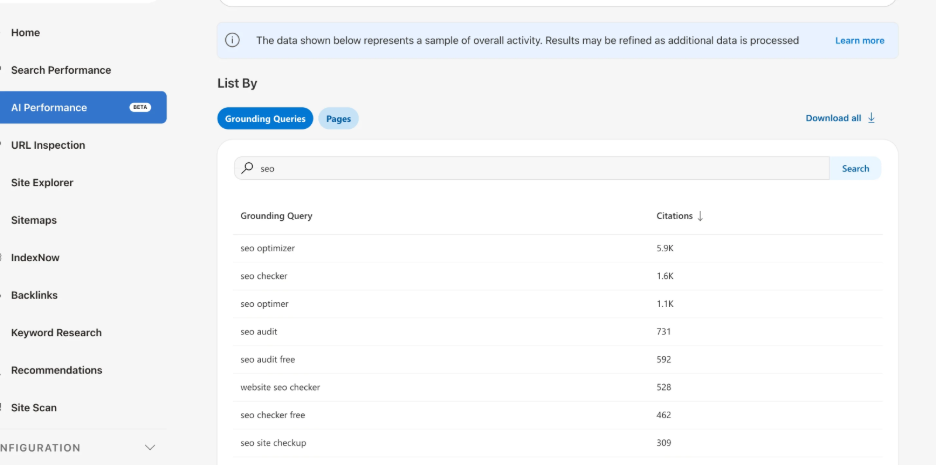
Bing takes this a step further in Bing Webmaster Tools, offering a specific tool called AI Performance Report. This shows you how the content on your site is used by Microsoft Copilot and other partner platforms.
Some of the key metrics provided by Bing’s AI Performance Report includes:
- Total citations: how often, overall, your content is used in AI-generated answers
- Average cited pages: the daily amount of unique URLs cited by AI
- Grounding queries: search phrases entered by users that result in your content surfacing
- Page-level citation activity, plus trend timelines
This is all super useful, but what Bing’s AI Performance Report doesn’t measure is important to note at the same time. Unlike GA4 or Search Console, AI Performance Report does not report click-throughs or user behavior.
What are the limitations to current AI traffic tracking?
With all this, of course, we do have to establish the limitations of these tools, too — a lot of it comes back to the ambiguity and unclear (or just non-existent) citing of different other AI platforms themselves.
For example, AI referrals may not always have clean referrer data. Some AI platforms don’t send clicks at all, meaning you can see citations but no traffic — this is a significant one. And lastly, overall, analytics tools and AI features aren’t standardized; definitions vary, as does how they interact with queries and source material for their “answers.”
What should SEO teams be asking about AI traffic in the face of this?
So, considering this, here’s some questions you should keep top of mind as an SEO team:
- Is this traffic real human users, or bots? Just as AI is proliferating, so are bots. Obviously, those are useless for your business — it’s humans who meaningfully interact, share, and purchase your goods or services. This means it’s important to track engagement signals too — bounce rates, pages per session, etc. — to validate the quality of the traffic. This becomes more important as AI referrals grow.
- Which AI platforms are driving visibility? Pay attention to which AI sources send traffic versus simply cite your content. Prioritize accordingly from there.
- How is your content strategy evolving with this AI-influenced ecosystem? AI platforms favor clear answers, structured content, and authoritative pages. By focusing your SEO around these principles, you’re putting yourself in a better position to improve the rates of your content being cited and in turn referring users to your site.
Looking towards what’s next, plus getting help navigating AI analytics and SEO
As for where things are moving, expect expanded features from Bing and other platforms in the future — showing more about click-through signals and deeper intent data, for example. We also expect GA4 and Google Search Console to likely refine AI traffic and AI answer performance tools.
Overall, the continued evolution of generative engine optimization — or GEO — is becoming a distinct skillset combining both traditional SEO and AI analytics.
When it comes to these changes, we’ll be the first to admit stuff can get pretty daunting, pretty fast.
We also provide assistance with GA4 custom channel setup, including setting up reporting that aligns with your business’ specific goals.
All of this together, plus overall strategic guidance can help you adapt for full AI answer visibility and referral, instead of just traditional search rankings. Professionals like Fujisan can provide expert support for integrating new tools like AI performance reporting with your broader, existing SEO strategy, freeing you up to actually focus on your business itself!