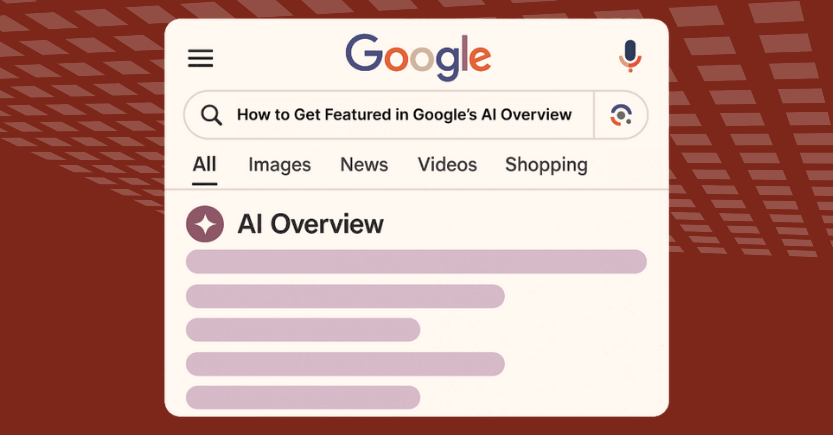
AI overviews are one of the most — and arguably the most — eventful changes to search engines that have happened in the last many years. Although some users will end search queries with “-ai” or use tools like the https://udm14.com/ code to block Google’s generative AI functions on search engine results pages, the vast majority don’t — so the top result they see on Google’s SERP is an AI LLM-generated answer to their query.
But we’re getting ahead of ourselves.
First, AI overviews: a search feature providing AI-generated answers to many queries, which are generated by scraping other web sources.
They can be informational or, to an extent, commercial — and because they are themselves not quality controlled by anything (or anyone) who can critically analyze the sources from which these answers are generated, they can also be of varying levels of truthfulness.
According to a recent study by SEMRush and Datos, AI overviews appeared in just over 13% of desktop searches in March of 2025; this marks a 102% increase from even January of the same year. The vast majority of these — about 88%, according to Search Engine Land — were found to show for search queries with an informational intent, with fewer appearing for searches with a commercial intent.
However, while they aren’t as common in obviously commercially-intended searches, the blurred lines of search intention plus the overall increase of AI overviews has an increasingly significant impact on online marketing.
When they do appear — which they’re doing more often every month — they dominate the search results. They appear first in the fold, above paid search ads, which are in turn above organic results. This is impacting both paid and organic click-through rates, placing pressure on advertisers to increase bids to be more competitive in SERPS and increasing the costs per click and overall cost.
User behavior changes with AI-first search results
This is what you have to keep an eye on and where we have to adapt.
With the rise of AI-first search results, the sheer real estate it takes up, its favorable positioning, and just generally how Google is prioritizing it at the expense of others’ search entries — organic and paid — we’re seeing a corresponding increase in zero-click searches, or “immediate answer” formats.
We’re now seeing far more people skimming the AI overview and then abandoning the SERP. Essentially: While AI overviews aren’t necessarily providing accurate information, they provide sufficient enough information in a tone that feels authoritative to search users to where they are less likely to click through the actual search results to learn more.
This means declining click-through rates. Studies by both Amsive and Ahrefs — plus many others — have pointed to this; the Ahrefs study in particular indicated, based on an analysis of 300,000 keywords, a greater-than 34% drop in ad position when an AI overview was present.
One thing to note: Branded keywords have been found to be less likely to trigger AI overviews — a less-than 5% likelihood, compared to the aforementioned 13+% likelihood in overall searches as of March 2025.
How paid search strategy must adapt (and further implications for organic content)
So, what to do about it?
First, refocus on high-intent, long-tail keywords.
As we’ve alluded to above, AI overviews are most likely to be triggered by more generic, informational intent search queries. Thus, when you focus on these sorts of queries in your campaigns, you’re focusing on a realm that’s most likely to be competing against AI overviews.
More specific, highly-focused searches, on the other hand, have two advantages: 1) An AI overview is less likely to be triggered, and 2) if one is triggered, it often fails to deliver relevant (or accurate) insights, pushing users to interact with more paid and organic search results — ones made by actual experts that actually address what they’re looking for in their search.
Basically: Understand AI overviews’ weaknesses — particularly when it comes to accuracy and superficiality — and focus your efforts there.
One of these is emphasizing conversions over pure clicks. Now more than ever, you have to pay attention to your return on investment and let that be a driving factor in determining your moves.
Because of the rise of zero-click searches, focusing on conversion-based PPC bidding strategies will likely be more successful even if they result in lower web traffic.
At the same time, understand the importance of enhancing your brand in this new environment.
This is good for two reasons. First, it’s a good move in general because the stronger your brand (and its site) is, the less fully dependent you become on, for example, Google and other search sites to lead users your way. The more you can get people deliberately visiting your site (or social media, or other platforms) without depending on Google, the better — even if that’s an uphill battle in today’s information ecosystem.
The other reason why building up your brand’s strength and authority is important? This increases the likelihood of being featured in AI overviews, which, when clicked further on, will expand with bullet points that “cite” their source. Which could be you!
Building a strong, trustworthy presence across multiple parts of the web — for example, your site, Reddit, YouTube, etc. — will work in your favor, as Google’s system recognizes “brand authority” if it can draw from a robust grouping of online sources that together suggest you’re a trustworthy, authoritative source.
The emergence of ads within AI overviews
So with all this said, it is occasionally possible for ads to be served within an AI overview — as of August 2025 this is true in English in the US, and Google says they’re expanding it beyond this shortly. Both the search query itself and the contents of the AI overview are considered when determining whether a paid search ad would be relevant and can be included.
The channels which are eligible for ad placements in AI overviews include Search, Shopping, and Performance Max campaigns.
For best practices here, recognize what we discussed above as far as when AI overviews are triggered and how ad placements are determined; i.e., they’re most likely to appear on relatively open-ended but moderately complex answer-seeking queries, and ads whose content best aligns with the AI overview “answer.”
If this is your goal, Google’s own automated solutions — smart bidding, Performance Max, and broad match keywords, for example — provide its system with a wider range of signals that increase your chances of being served in relevant AI overviews.
Common issues, challenges, and risks
Of course, the implications for AI overviews are significant.
There are a couple things here, including what we’ve already discussed: the rise of zero-click searches and the subsequent massive traffic hit that’s happening across the internet to everything from digital newspapers to brand websites and more.
For this, we’re all going to have to start rethinking our traditional paid ad strategies — plus all the other aspects that impact and are impacted by them. Click-through rates and general engagement are all being negatively affected as paid and organic search results are pushed even further down the SERP.
Beyond that though, another potential problem: overrelying on AI-automated tools and neglecting to put the necessary, ya know, human evaluation into it all.
AI-powered channels (PMax, for example) diminish the amount of control you have over when, where, and how ads appear. These AI solutions are really a “black box” that have shown to be effective often, but are equally prone to unpredictable swings in performance as systems are shuffled, channels reprioritized, and you have no manual control over adapting, tweaking levers, and shifting strategy.
At the same time, this automation proliferation flattens everyone doing this job, minimizing potential disadvantages, but also advantages one could generate.
So, if “everything” is automated, what is your own, human-powered critical approach to stand out? If you don’t have an answer, start fixing that yesterday.
The bottom line is that AI overviews are seriously reshaping SERP dynamics, slashing click-through rates significantly, and you have to adapt: Look towards realigning around high-converting, more niche, and possibly branded keywords instead of fishing for volume.
Certain machine learning “AI” tools can be helpful for more menial campaign automation and targeting — smart bidding, PMax, for example — but be careful to test against existing campaign structures and not just blindly hand the reins over.