The zero-click search is a concept that’s been around for years, but is becoming increasingly dominant when it comes to how users interact with search engine results.
This is due to a few factors. The rise of large language models — AKA generative AI — is one of them, not just with people using ChatGPT, but with Google investing so much of their resources into AI and significantly altering users’ experience by promoting Google AI Overviews to the top of SERPs.
Because of this rapid shift the last few years, the landscape around search engines is changing a lot for businesses who are used to getting much of their traffic through Google searches.
Here, we’re going to look at what’s happening, what it means for your business’ digital marketing, and how you can evolve with it.
What is a zero-click search?
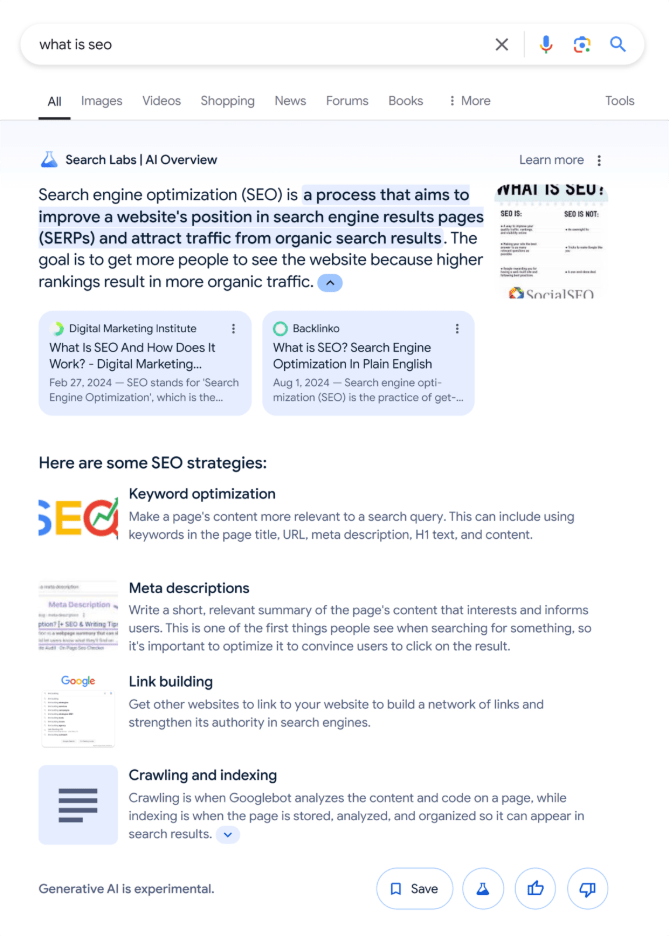
Before we get into it, the basics: A zero-click search is one where Google “answers” the query directly on the SERP without the user having to click on and interact with any of the actual results entries.
A zero-click search can happen when users instead read from featured snippets, knowledge panels, local packs, or AI overviews.
These have become especially prominent more recently as Google has promoted these features more heavily, particularly the AI overviews positioned at the very top of the SERP which Google has been banking on, making it so users have to be quite deliberate about scrolling beyond that to find actual entries.
Why that’s leading to less traffic — and other ways the zero-click search is impacting your marketing
In many ways, the basic impacts of this development are pretty intuitive: By pushing organic results down the page and normalizing instant “answers” on the SERP — which are, famously, not always accurate — Google is effectively putting up multiple little barriers to people finding organic results, which over time is further affecting their own ingrained tendencies.
Otherwise, some other factors that are leading to fewer clicks on actual sources:
- Users increasingly searching on mobile devices, whose smaller screens mean less viewable real estate at a time, pushing organic results even further down.
- An increase in voice searches, which tend to include more components on the SERP leading to a zero-click search like AI overviews or featured snippets.
- Users becoming increasingly used to “instant answers” as these features become more ingrained, and their behavior reflecting that by being less likely to scroll and look for further sources.
But how do these changes affect the numbers — beyond just “search traffic down” — and how should you evolve your approach in response?
First, we’re seeing a reduction in click-through rates no matter how highly your site (or other content) is ranking on search engines. Obviously you still want to be high-ranking, but it’s pretty universal: No matter where you rank, your click-through rates and traffic from search results is down.
Because of these declining metrics from search traffic, that means it’s a good move to really consider how to diversify your strategy — not just away from relying on search traffic, but conceptually, away from traffic in general.
Basically: Look to emphasize brand exposure over traffic.
Even from just a search engine focus, zero-click searches can still build awareness of your brand, especially with things like featured snippets and knowledge packs. Not only do these build basic awareness for your brand, but they can reinforce users’ sense of your credibility and authority along with that name recognition.
However, in adapting your approach accordingly, that also means you need to reframe metrics for success; if you plan to focus less on traffic and more on building up your brand recognition through search, you can’t measure the latter the same way you’ve been measuring the former for years.
In fact, you’ll often need to measure this approach via proxy metrics instead of directly.
At the end of the day though, although click-through-rates and search traffic are plummeting, you can still use this new Google ecosystem to dominate visibility.
Basically: Google’s utility for you as a marketer is changing; if you try to keep using it the same way, it won’t be nearly as effective as it once was — but if you evolve alongside it, it can still be quite useful.
KPIs to prioritize in a zero-click world
So, even without being able to use the metrics we used to rely on as effectively, we still want to be able to quantify — again, whether by proxy or directly — people’s interaction with you, in this case in the context of search results.
If we’re moving away from click-through rate and general traffic, what metrics are we then shifting more towards in this context?
To start, we’re prioritizing impressions more and valuing clicks less (which you can see using Google Search Console). In this vein, we’re also valuing brand search volume more too, which is a good example of a metric being a useful proxy: Growth in search volume implies an increased brand recognition that’s being acted upon by users.
We also want to look at SERP feature ownership — featured snippets have a huge advantage, so working to get your site into featured snippets is obviously a win!
At the same time, we’re zooming out — looking at each arm of your marketing efforts in a vacuum is always myopic, but even more so given these changes. This means we’re looking more at engagement metrics from other platforms like social media, email, and elsewhere to infer trends, what’s working, what could be improved, and so on.
Other strategies to optimize for zero-click search engines
Other than shifting what you value when it comes to quantifiable metrics, what about steps to take?
- Add schema markup — AKA structured data — to your web pages. Schema qualifies you to appear as rich results or rich snippets, which are extremely valuable especially in this new zero-click environment for providing context and further information to users directly on the SERP.
- Structure your content with featured snippets and Knowledge Graphs in mind. Like we mentioned earlier, these are two big parts of the zero-click ecosystem. To improve your chances of being in a featured snippet or Knowledge Graph, this means providing concise answers, clearly communicating (for example with bullet points), and targeting question-based queries. Basically: Think about what information people might want to know that’s relevant to your business, industry, and expertise, and provide that for them in clear, easily-readable ways.
- Leverage branded queries to maintain awareness!
- Be an expert in your content — show that you’re an authority. Not only does this increase your chances of being in a featured snippet, but it also shows people that they can come directly to you when they have future questions.
Why to adapt now (seriously, don’t wait!)
First, getting in early will give you a competitive edge from getting your foot in the door while competitors are lagging behind. If you adopt these new principles to optimize for zero-click sooner rather than later, you’ll own valuable SERP space and can build from there a “positive spiral” that both gives you a head start and creates a foundation to be one step ahead in improving.
This is also just as much about future-proofing as anything else; as it looks now, SERP features promoting zero-click searches will only expand. Adapting now avoids not just losing visibility now, but falling further behind as those new features and the algorithm keeps moving in this direction.
Furthermore, just from a return-on-investment perspective, if you don’t adapt, you’ll be spending more and more money and getting less to show for it. On the flip side, even if zooming out and focusing more on visibility, impressions, etc. don’t immediately lead to more conversions and revenue, it boosts brand recall, grows your audience, and together helps drive more long-term conversions down the line.
Essentially: It’s a marathon, not a sprint. Get a start now and think beyond today and you’ll be in a good spot.
What can you do right now to start? Begin by shifting your reporting to include impression data, SERP share of voice, and snippet ownership rates. From there, evaluate how, in the bigger picture, you can move away from an emphasis on traffic and towards an emphasis on a wider strategy that at times can’t be measured via one-to-one metrics, but which requires evaluating success via proxy metrics, critical thinking, and assessing patterns accordingly.
And of course, you can always reach out to professionals like Fujisan Marketing for support in adapting to this new zero-click search engine world.