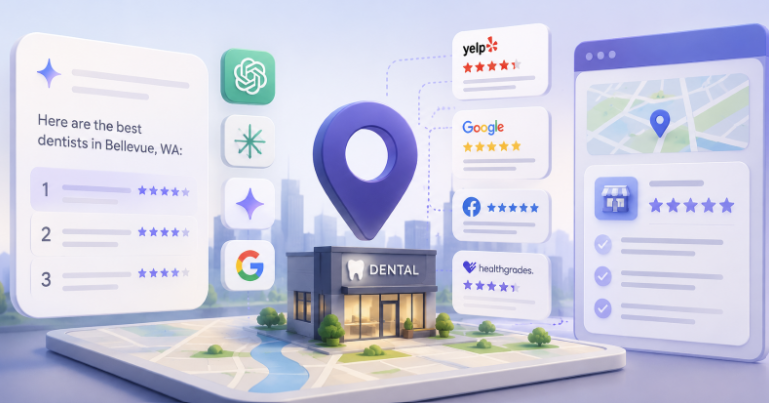
In earlier renditions of the internet ecosystem, someone looking for a dentist in, say, Bellevue, Washington would likely search “best dentist in Bellevue” into Google and scan through some results listings.
Today, a significant amount of people who would be doing that will now ask ChatGPT, Perplexity, or Google’s AI Mode or AI Overviews and in turn get a short answer with two or three specific businesses named. If you’re not one of those two or three, you effectively don’t exist in that interaction.
While public opinion on AI is hardly unanimously in favor, we know that still, 45% of consumers now use ChatGPT or other generative AI tools for local business recommendations per the 2026 Local Consumer Review Survey.
This has significantly changed the ecosystem in which we’re functioning — let’s look at how, why it matters, and what to do about it:
What are the stakes (and why this probably isn’t a flash-in-the-pan trend)?
There are three numbers that help illuminate the issue.
- SOCi’s 2026 Local Visibility Index looked at over 350,000 locations across 2,751 multi-location brands. Of those, only 1.2% of locations got recommended by ChatGPT. At the same time, only 11% were recommended by Gemini, and 7.4% by Perplexity. On the flip side, these same brands appeared in Google’s local three-pack just under 36% of the time.
- At the same time, AI local visibility is up to 30 times harder to earn than traditional search visibility per the same SOCi research.
- In retail, only 445% of brands leading in traditional local search also showed up among the most recommended in AI results.
Essentially: Winning on Google and other search engines doesn’t mean you’re automatically winning in AI, too.
At the same time, Google itself is changing; as you’ve surely noticed just as an individual user, their shifting of their priorities towards AI is immediately apparent — AI Overviews, for example, now appear in roughly 40% of local business queries, and a significant amount of those queries end without any further click to an actual destination site from the user.
The aggregation model, or how AI “decides”
To start, AI doesn’t rank pages. Rather, it synthesizes a recommendation based on patterns it’s able to identify across the web. (This is, of course, a mechanism that’s the basis for the hallucinations that it’s provided —
So, because of this, a business that is, for example: written about in local publications, quoted in industry newsletters, featured on a podcast, reviewed across platforms, and listed consistently in relevant directories generates a rich, recognizable pattern — on the flip side, a business that has a “only” a good website and a moderate number of Google reviews generates less of one. The pattern AI will “recognize” then favors the first business.
At the same time, AI is an aggregator, not a verifier of facts. Inaccurate, outdated, out-of-context, and partially true information can easily surface from third parties, instead of the business’s own message. Obviously, this is a lose-lose for both users trying to search for accurate, helpful information, and also for the business being portrayed.
With this in mind, let’s look at three factors that have some of the biggest impact here:
The big three factors
To begin, let’s look at what helps determine “the floor” of how your business is aggregated by AI:
Listings and NAP consistency: the floor
This is essentially the foundation we’re working with.
Only 68% of business contact information provided by ChatGPT and Perplexity matches details on Google Business Profiles, per SOCi’s 2026 research. That means 32% doesn’t match! Effectively, a full third of businesses are feeding AI incorrect or conflicting information about themselves.
In the 2026 Local Search Ranking Factors survey, three of the top five factors that influence AI visibility are tied to citations. Google Business Profile is still the number one factor.
In practice, this is what quietly kills loads of AI visibility — if, for example, your hours are different on Yelp than on Google, or if your old address is still on three different directories, these discrepancies push AI away. Basically, it “loses confidence” in pattern recognition because of the disparate information available.
Reviews: the power boost signals
Now, reviews aren’t just creating a public-facing star rating anymore. Instead, their contents are shaping the ways AI describes you, and how it “recommends” you to others.
Whereas before, star rating was disproportionately impactful, now specificity in the review text itself matters just as much. For example, a review asserting “same-day water heater install, was on-time, fast, and did a good job” gives AI much more to go off of than a review saying just “great service” (which is itself better than just a star rating alone).
In BrightLocal’s 2026 survey, they found almost 70% of consumers won’t use a business rated below four stars, with 31% primarily considering businesses rated 4.5 stars or higher; at the same time, they found 74% of shoppers care primarily about reviews from the last 90 days. Recency is heavily weighted for AI — addressing negative or outdated feedback before AI catches on is important.
Third-party mentions and off-site presence
This is often where the gap lives for mid-market brands that have decent websites but mediocre PR.
ChatGPT, for example, pulls from business websites 58% of the time, mentions of said business 27% of the time, and online directories about 15% of the time. Roughly a quarter of the signal for ChatGPT is what other people say about you, not what you say about yourself. According to some researchers, the biggest influence on local AI search visibility is a presence on expert-curated “Best of” lists, plus dedicated pages specifically for each service.
Further backing this up, Search Engine Land’s 2026 researchers found similar: AI systems rely on identifying patterns implying trustworthy entities and relationships to “understand” and cite brands.
Basically: Content gets brands found — AI decides who gets recommended further, based on positioning and outside presence across the internet. In practice, this can look like local news coverage, industry publication features, podcast appearances, guest articles, chamber listings, “Best of” roundups, and so on.
Where traditional SEO matters, where it doesn’t, and what’s the playbook from here
To start, we want to affirm: The fundamentals haven’t disappeared.
Many of the same signals that influenced traditional local rankings — on-page optimization, reviews, perceived authority — also impact AI visibility. What’s really changed is the ceiling and, with it, the opportunity cost of underachieving there.
Now, you should still be doing the foundational parts of traditional SEO, but you can’t just rely on that. Otherwise, you can be doing the old SEO ways right and still not appear in AI recommendations. That’s because AI’s pattern recognition weighs clarity of entity, third-party validation, and structured content differently than Google’s local pack.
In other words, you still have to do the basics of the old ways, but it’s now not enough to just do that — now you have to adapt and shift your remaining time and human resource more towards this new AI-based discoverability.
The next steps from here
To make things easier, here’s a list of practical action items, prioritized:
- Audit NAP across the top citations. This means not just Google, but industry directories — for example, Avvo for law, Houzz for home services, Healthgrades, for medical, etc.
- Fix the GBP primary category and add relevant secondary categories. This is still the single biggest Local Pack factor for 2026, which is still important.
- Build dedicated pages for each service, tied to geography. This is the second biggest influence on local organic rankings and, similarly, a top factor for AI visibility.
- Set a steady review cadence. Two or three new reviews per month is much more impactful than a big push all at once. If you provide good service and cultivate a relationship with your customers, they’ll often be happy to leave a review if you ask. Furthermore, being honest and letting them know it’s especially helpful if they mention specific services you excelled at or problems you solved can often go a long way! (We know this from experience!) This is the language AI will latch onto.
- Prioritize third-party mentions (and assign your resources accordingly). Local press, contributor pieces in industry publications, a few podcast appearances a year, association listings, and so on — the aggregation of these build AI’s “confidence” in your favor.
- Add LocalBusiness and FAQPage schema. Cleanly-structured data lets AI extract facts without having to “guess.” For obvious reasons given its mechanisms, you want to make this as easy as possible.
- Publish FAQ-style content that matches people’s queries to AI. Conversational phrasing with direct answers and specifics are the pillars here.
How to measure in this new ecosystem when traffic stops telling the whole story
Because past traditional metrics no longer carry as much weight as they used to, now we need to adapt accordingly.
This isn’t to say traditional rank tracking doesn’t still matter; it does, but rather, is just incomplete now. As AI-driven and zero-click journeys increase, traditional SEO metrics become less all-consuming. Attribution fragments across search, maps, AI interfaces, and third-party platforms, obscuring your ability to interpret data.
Because of this, you want to spread out to further tracking:
- AI citation presence. Test queries in ChatGPT, Gemini, and Perplexity, ideally once a month.
- Your share of recommendations in branded AI queries.
- Location-level actions, such as calls, directions, and bookings.
- Branded search volume trends.
We actually wrote more on measuring AI traffic earlier in 2026, if you want to read more on that subject.
Bottom line
This isn’t a complete departure from the SEO factors that were valuable in the past, simply an expansion and reassignment of where the value lies. Addressing this, adapting your philosophy, and building out an approach from there will put you in a good position moving forward in this new environment.
And we’d be remiss if we didn’t mention: If you feel like you’d benefit from a set of professional eyes to help you out with this adjustment, please reach out to our team at Fujisan today!